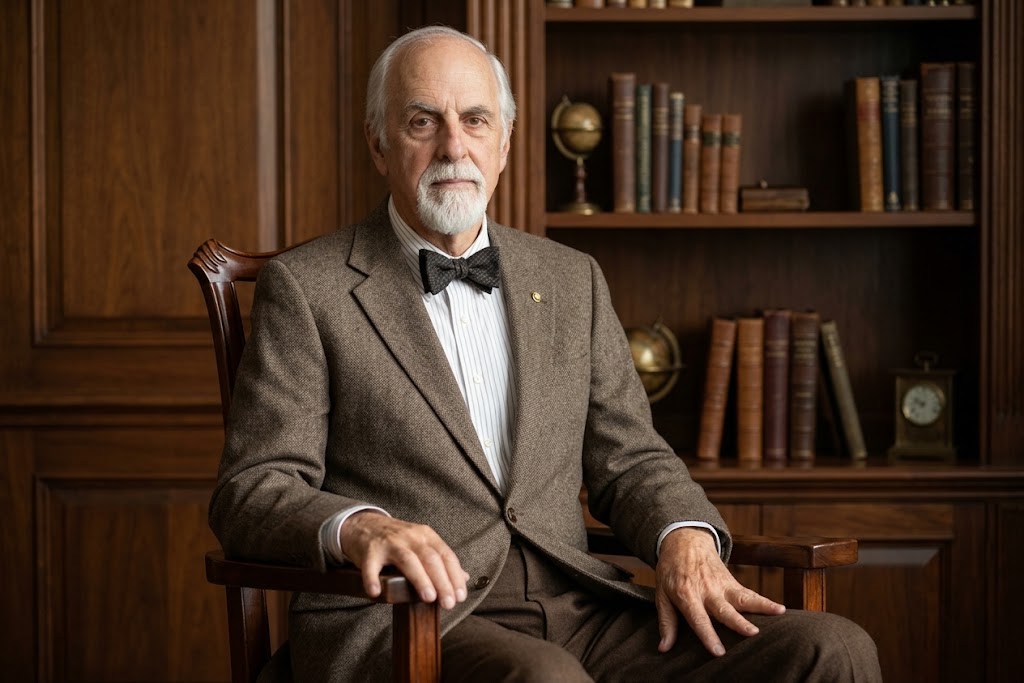
David McClelland was a pioneering motivation psychologist who identified three fundamental human needs—achievement, power, and affiliation—and developed the TAT-based method to measure them. His work connected individual psychology to societal outcomes, challenged IQ-based assessments, and reshaped how organizations think about competency and motivation.
David McClelland: A Brief Introduction
David McClelland (1917–1998) was an American psychologist renowned for his work on human motivation, particularly the Achievement Motivation Theory (also called Need Theory or n-Achievement theory). He pioneered the study of how psychological needs drive behavior and how these needs vary across individuals and cultures.
Life and Context
- Born in Mt. Vernon, New York; earned a BA from Wesleyan University (1938), an MA from the University of Missouri (1939), and a PhD in experimental psychology from Yale (1941).
- Joined Harvard University in 1956, where he taught for 30 years and chaired the Department of Social Relations (1962–1967).
- Later became distinguished research professor at Boston University after retiring from Harvard in 1986.
- Ranked as the 15th most cited psychologist of the 20th century by Review of General Psychology.
Core Theory: Three Dominant Needs
McClelland contended that three dominant needs underpin human motivation, with their relative importance varying among individuals and cultures:
1. Need for Achievement (n-Ach)
The drive to excel, to accomplish challenging tasks, and to attain a standard of excellence. People high in n-Ach prefer moderately difficult tasks, want clear feedback, and take personal responsibility for outcomes. McClelland linked this need to entrepreneurship and economic development.
2. Need for Power (n-Pow)
The desire to influence, control, or have impact on others. This need manifests in leadership, persuasion, and the pursuit of status. McClelland distinguished between personalized power (self-serving) and socialized power (oriented toward group goals).
3. Need for Affiliation (n-Affil)
The desire for close, friendly relationships, approval, and belonging. Those high in n-Affil seek harmony, avoid conflict, and prioritize interpersonal connection over task accomplishment.
Later work added a fourth motive system: avoidance motivation—the need to avoid failure, rejection, or harm.
Methodology: The Thematic Apperception Test (TAT)
McClelland developed an innovative method to measure motives that bypassed self-report bias. Using the Thematic Apperception Test—a set of ambiguous pictures developed at Harvard by Henry Murray—he analyzed the stories people told about the images, scoring them for themes of achievement, power, and affiliation.
His experimental logic: if a motive is active, it should appear in imaginative stories. When participants were made to fail at a task, their TAT stories contained more achievement imagery—confirming the measure's validity.
Major Work: The Achieving Society (1961)
This landmark book analyzed the role of achievement motivation in economic development and the rise and fall of civilizations. McClelland argued that societies with high levels of achievement motivation—measured through children's stories and cultural products—tend to experience faster economic growth. He applied these ideas practically through achievement training programs in India and other countries.
Critique of Traditional Intelligence Testing
McClelland argued that IQ and personality tests were poor predictors of job competency. He advocated for competency-based assessments—evaluating demonstrated skills in relevant contexts rather than standardized scores. His ideas inspired the modern competency movement and became widespread, albeit not standard insight or practice everywhere in corporate hiring.
Critiques
- Conceptual ambiguity – Later reviews noted some vagueness in McClelland's definitions of motive concepts and their interrelations.
- Measurement issues – TAT scoring requires trained coders and raises reliability questions.
- Cultural variation – While McClelland acknowledged cultural differences, critics argue the framework reflects Western individualist values.
- Oversimplification – The three-need model may not capture the full complexity of human motivation.